lunar new year
Contrary to popular belief, Japan doesn’t really celebrate lunar new year - the solar/Gregorian new year is the one that is a national holiday and widely observed. My Japanese school teacher told our class today that the real celebrations are happening in Yokohama actually. Yokohama is about an hour away by regular train (not Shinkansen), so an evening trip would’ve been very doable, but it wasn’t on my radar at the time. Something to keep in mind for next year though.
I decided to celebrate the main way I knew how - by going to a Chinese restaurant. My experiences with Chinese restaurants in Japan have been pretty disappointing so far, and honestly, I actually think the Chinese food in the US is way better. There are regions of Tokyo that are more Chinatown-y, actually close to where Miles’s school is located (and where my school will be relocated to next quarter) around Takadanobaba and Ikebukuro. We did walk around that area over the weekend since we’ve been apartment hunting there, and it was the first time I saw restaurant menus/ads that actually looked like proper Chinese food. I have yet to try any of them though.
We ended up going to a restaurant near our current place, called 悟空 (Goku). (The name of the restaurant was only in kanji, and I just kept reading it in my head as ‘wu kong’ because that’s how it would be pronounced in Chinese…only learned that it’s called ‘Goku’ in Japanese after running it through Google translate just now.) Earlier this week as we were walking around, I told Miles that I was really looking for a Chinese restaurant with big circular tables and lazy susans, none of these single booth situations that are in literally every single Japanese restaurant. I peeped into 悟空 and saw a circular table, so that was a good sign, but there was a plastic divider in the middle so that it could seat 2 small (1-2 people) parties if needed. It really made me think about the stark contrast between Chinese and Japanese (or maybe just Tokyo) culture - emphasis on family and large group shared dining vs the solo dining experience. I wonder if the cultural differences diminish as you leave the city and enter more countryside areas, because I think of Asia as being a very family-centric culture in general, but it’s interesting to see that it isn’t nearly as apparent during my time in Tokyo so far. When I was talking to Zahra yesterday, she told me about her huge family in Bangladesh, and how life in Tokyo has been far more isolating, which I think is a shared experience for many coming from large communities into Tokyo.
Anyways, because 悟空 was potentially a Chinese name (many of the other restaurants I was looking at clearly had Japanese names), I got pretty excited. I really want to go to a restaurant where people actually speak Chinese. But when we walked in, it was all Japanese people, the menus were in Japanese, and I was 99% sure the waitress was Japanese too. I saw my favorite dish on the menu - 回锅肉 or Hui Guo Rou, which was written as ホイコーロー (hoiko-ro-) on the menu, not even the kanji was included. The Japanese transliteration of Chinese is even worse than than the English one in my opinion, it amuses me so much in a way I can’t really explain.
How was the food though? Honestly, it was the tastiest Chinese food I’ve eaten in Japan so far, but it was nowhere close to real Chinese food. Only the 餃子 (gyoza or jiao zi, the kanji is actually sometimes preserved for this one) tasted faintly Chinese. I’d come back, but it’s kind of like going to a good Chinese-American restaurant - like, it’s not the real deal but at least they tried. The other places we’ve been to in the past were more like fast food chains - it’s like going to a “Chinese” restaurant in the US that also serves chicken tenders and fries on the kids menu and has a page for “sushi” (like deep-fried rolls with cream cheese). This one at least scratched the itch. (Also, can I just mention how basically the only vegetable I’ve eaten in a restaurant is cabbage?)
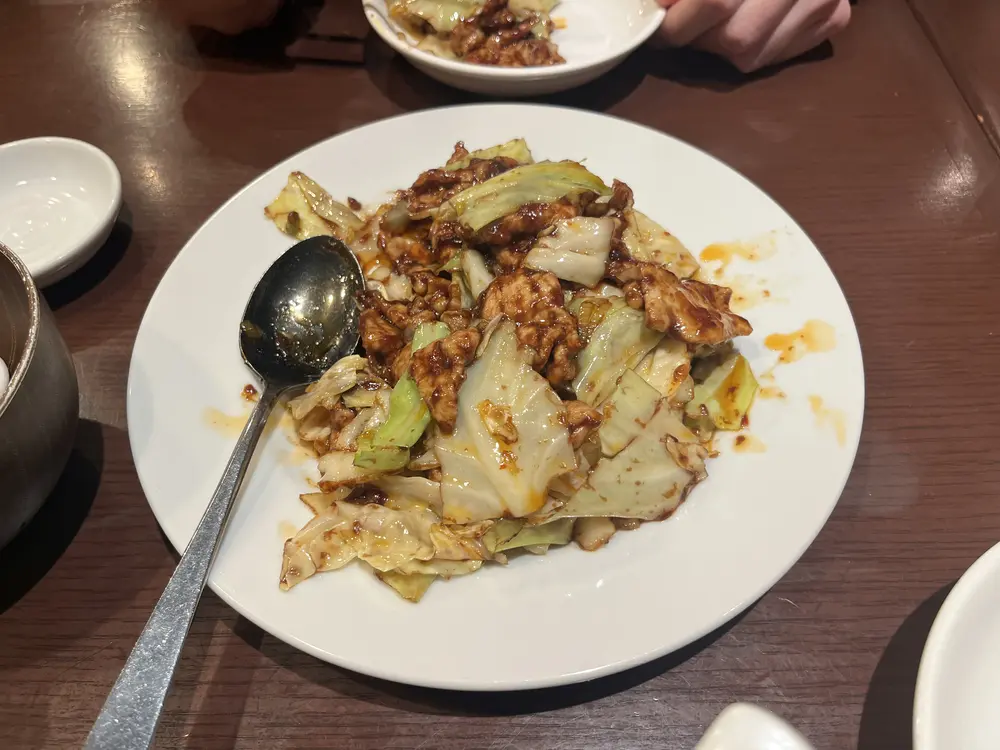 our 回锅肉
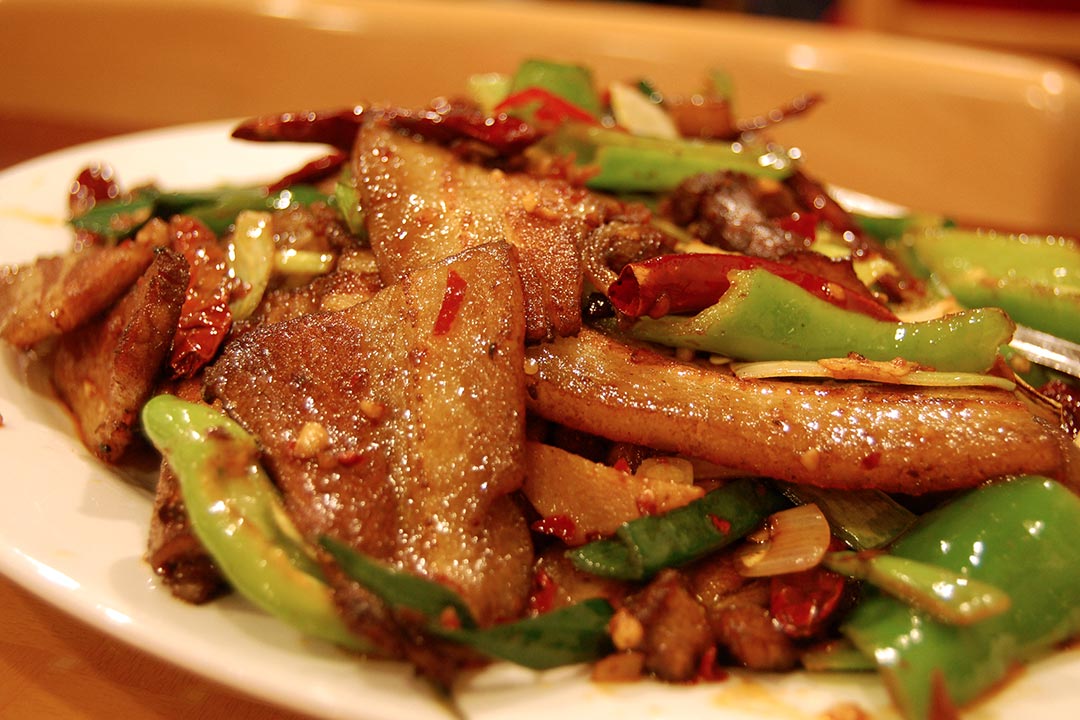 what I was hoping for (taken from the internet)